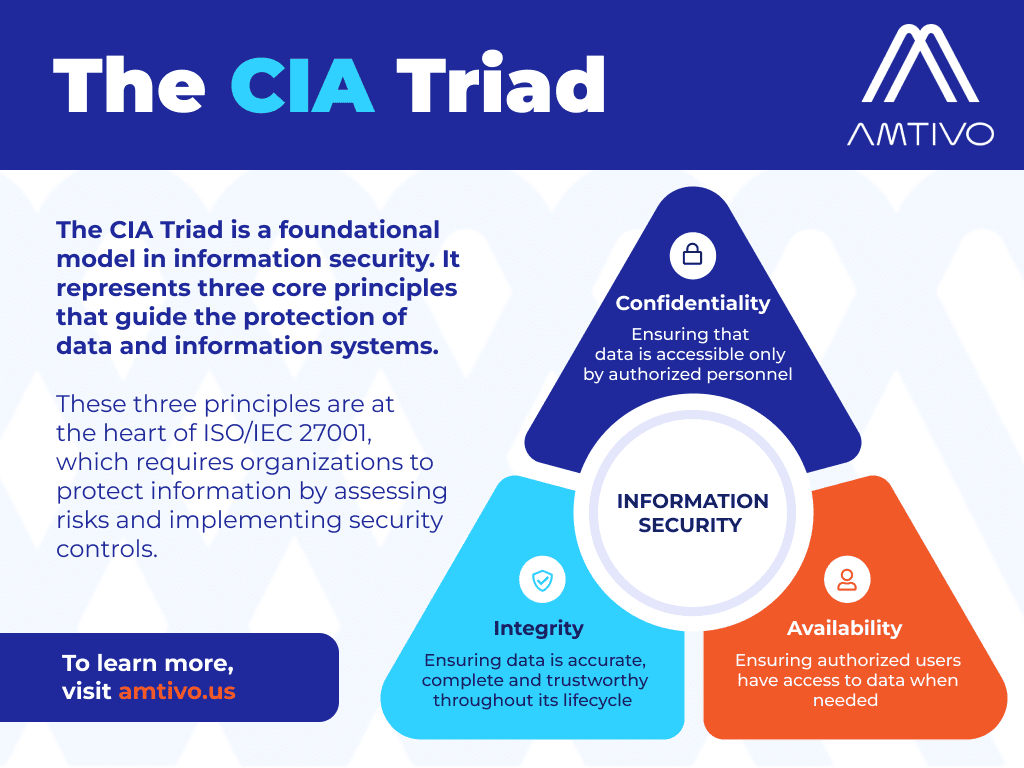
ISO 27001 was developed by the International Organization for Standardization. It is part of the ISO 27000 family, a group of international standards focused on information security.
The standard offers a blueprint for creating Information Security Management Systems (ISMS) that help businesses protect their sensitive information from security threats, including:
- Unauthorized access to systems and networks
- Theft, including customer data or company IP
- Damage to networks and systems, such as through ransomware attacks
- Security incidents, such as lost or poorly stored data
- Data breaches
ISO 27001 certification helps businesses put measures in place to help identify potential security risks and implement effective safeguards to tackle these threats. Click here to download our guide.
ISO 27000 Standards
ISO 27001 is part of the ISO 27000 series of standards. Each standard addresses different aspects of information security, providing a consistent approach to safeguarding data, preventing theft and loss, and managing security risks.
Many businesses prioritize obtaining ISO 27001 certification, as it offers official recognition, while the other standards serve as valuable guides and supportive information.
ISO 27000 standards include:
- ISO/IEC 27000: Defines terms and definitions used throughout the ISO/IEC 27000 family of standards.
- ISO/IEC 27001: Specifies the requirements for establishing, implementing, maintaining, and continually improving an ISMS.
- ISO/IEC 27002: Provides a code of practice (guidance) for selecting and implementing information security controls based on ISO/IEC 27001 Annex A.
- ISO/IEC 27003: Offers guidance on the implementation of an ISMS in accordance with ISO/IEC 27001, including project planning and organizational context.
- ISO/IEC 27004: Provides guidance on monitoring, measurement, analysis, and evaluation of the ISMS to assess performance and effectiveness.
- ISO/IEC 27005: Focuses on information security risk management, offering methodologies aligned with ISO 31000.
- ISO/IEC 27006: Specifies requirements for certification bodies that audit and certify ISMS under ISO/IEC 27001.
- ISO/IEC 27007: Provides guidelines for auditing ISMS, including principles and managing an audit program.
- ISO/IEC 27031: Offers guidance for ICT readiness for business continuity (ICT-BC)—keeping IT systems operational during disruptions or emergencies.
- ISO/IEC 27701: Extends ISO/IEC 27001 and 27002 by adding requirements and controls for managing personally identifiable information (PII)—essentially a privacy information management system (PIMS).
Each standard in the ISO 27000 series includes the ISO/IEC prefix, indicating it is jointly developed by International Organization for Standardization (ISO) and the International Electrotechnical Commission (IEC), along with the publication year. For instance, ISO 27001 is officially ISO/IEC 27001:2022.
How Often Does the Publication Date Change?
ISO 27001 updates take place periodically to reflect evolving information security practices. The updates mean certified businesses are required to adapt their ISMS to meet new requirements and maintain compliance.
ISO 27001 has seen several updates so far, in 2005, 2013, 2017, 2022 and 2024.