Introduction
A decade ago, cyber attacks were considered an issue only for organisations and cyber security professionals to worry about. Now, they are everyone’s problem.
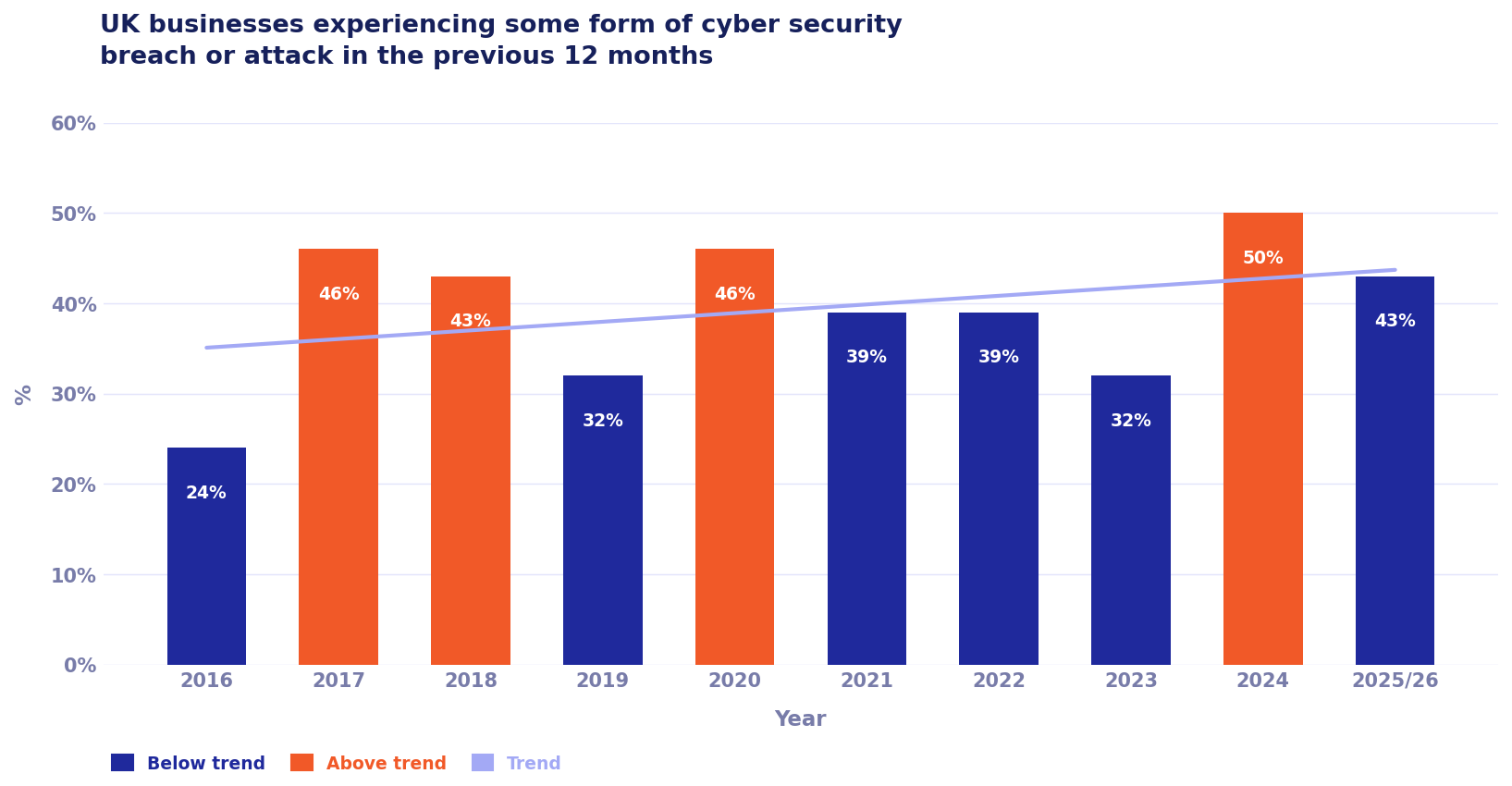
Cyber attacks have become a regular occurrence, affecting individuals, businesses, and governments worldwide. As data from the annual Cyber Security Breaches Survey shows, cyber crimes have been trending upwards in the UK, with some standout years.

What’s more, the survey only includes breaches organisations were able to identify and willing to report. So, the actual number is likely to be higher because of hidden and unidentified attacks. In addition to this research, the UK’s cyber agency, The National Cyber Security Centre (NCSC), has highlighted how the seriousness of the cyber threats facing the UK continues to escalate. According to the NCSC Annual Review 2025:
- 48% of reported incidents requiring support were “nationally significant”, meaning there was four nationally significant cyber attacks every week in 2025.
In terms of what cyber risks are concerning organisations, according to the Global Cybersecurity Outlook 2026 survey, 87% of CEOs identified AI-related vulnerabilities as the fastest-growing cyber risk over the course of 2025. Other cyber risks respondents believe are on the rise include:
- Cyber-enabled fraud and phishing (77% of respondents think the risk is increasing)
- Supply chain disruption (65%)
- Exploitation of software vulnerabilities (58%)
- Ransomware attack (54%)
As threats evolve, learning from incidents in the past can help to support greater cyber resilience. Here, we highlight some of the biggest cyber attacks of the last few years – the type of events businesses will be looking to avoid.
Biggest Cyber Attacks in 2026
ASOS data breach
In October 2026, UK online fashion retailer ASOS confirmed a data breach that exposed some customers’ personal information, including names and contact details.
According to ASOS, attackers gained access to an employee account by impersonating a trusted contact to obtain login credentials. These credentials were then used to access information held on third-party platforms used by the retailer. Some customers also received an unauthorised notification through the ASOS app.
ASOS confirmed that certain non-personal account information was also accessed, but its investigation found that payment card details and account passwords had not been compromised. The retailer restricted access to the platforms impacted and launched an investigation with cyber security specialists and relevant authorities. Its website and app continued operating throughout the incident.
This incident is a reminder of the real-world consequences of unauthorised access to sensitive identity data. For organisations, schemes such as Cyber Essentials and Management System Standards such as ISO 27001 provide a structured approach to managing information security, including areas such as access control, monitoring, and data minimisation, which may help reduce the likelihood and impact of similar incidents.
Eurail Interrail data breach
European rail pass operator Eurail is reported to have suffered a significant data breach, with the full scale of the incident becoming clearer in early 2026. Hackers are reported to have breached Eurail’s systems in December, and in February, a threat actor publicly claimed responsibility, stating they had stolen approximately 1.3 terabytes of data, including source code, database backups, and Zendesk support tickets, after the company is said to have declined to negotiate a ransom.
Media reports indicate that nearly 309,000 people may have been affected, having booked an Interrail or Eurail pass through the company’s direct channels or associated distributors. The data has reportedly been offered for sale on the dark web, with a sample dataset also said to have been published on Telegram.
Compromised records are reported to include names, dates of birth, passport numbers, email addresses, phone numbers, home addresses, and travel information. Some reports indicate that affected UK customers were advised to consider replacing their passports to reduce the risk of fraudulent use, at a current cost of £102 per replacement.
The attack is also reported to have had downstream effects on the EU-funded DiscoverEU programme. It is said to have issued its own warning that participants’ data – including names, ages, passport details, addresses, bank account numbers, and some health information – may have been exposed.
Media reports indicate that Eurail began notifying affected individuals towards the end of March 2026, several weeks after the incident became public and after the data reportedly appeared on a cybercrime forum. The company is reported to have notified relevant EU data protection authorities, as required under GDPR, and to be cooperating with law enforcement. Investigations remain ongoing.
Biggest Cyber Attacks in 2025
Jaguar Land Rover cyber attack
Jaguar Land Rover experienced a cyber attack in late August 2025, forcing a shutdown of its global production facilities and IT systems throughout September. The incident, believed to be a coordinated supply chain attack claimed by a group called Scattered Lapsus$ Hunters, caused significant disruption, with estimated losses of £50 million per week and impacts on thousands of employees and suppliers.
Investigations are ongoing with the National Cyber Security Centre, while the company works to restore operations and limit further damage.
LVMH luxury brands’ data breaches
French luxury conglomerate LVMH faced a series of cyber attacks targeting its major brands throughout 2025. Louis Vuitton’s UK operations were breached in July 2025, with hackers accessing customer names, contact details and purchase history.
This followed similar attacks on Louis Vuitton’s Korean operations, as well as Christian Dior Couture in May, marking three breaches within three months. While financial data remained secure, the incidents highlighted cyber criminals’ increasing targeting of high-end retail brands.
UK retail sector ransomware attacks
In a series of attacks highlighting commercial sector vulnerability, major UK retailers such as Marks & Spencer, Co-op, and Harrods were targeted by ransomware in April 2025. The attacks were orchestrated by the groups Scattered Spider and DragonForce, who exploited vulnerabilities via third-party IT contractors and used social engineering techniques.
The campaign began with a phishing attack that compromised a key IT supplier, allowing hackers to move rapidly between the organisations.
- Marks & Spencer endured a severe ransomware attack across more than 600 systems, leading to a 46-day online outage, theft of customer data, and a profit warning totalling £300 million – a record for a UK retailer.
- The Co-op’s IT and membership systems were targeted, and data on 6.5 million members was stolen, and extortion threats issued. This forced the retailer to operate manually for several weeks.
- Harrods prevented deeper infiltration but had to impose strict operational restrictions and limit internet access across its sites as a precaution.
All three incidents were linked to a single wave of attacks, leading to the arrest of four suspects aged between 17 and 20.
Biggest Cyber Attacks in 2024
Finastra data breach
In November 2024, Finastra – a major fintech company headquartered in London – suffered a massive data breach that exposed over 400GB of sensitive data, affecting financial institutions worldwide. The breach originated from unauthorised access to Finastra’s Secure File Transfer Platform, which is used to support client operations. It exposed the personal and financial information of thousands of customers.
The incident prompted a reevaluation of cyber security measures across the sector to safeguard against similar threats to the fintech industry.
Synnovis attack
In June 2024, ransomware targeted Synnovis, a private pathology provider for NHS trusts and GP practices in south-east London, including King’s College and Guy’s and St Thomas’. The attackers demanded a £40 million ransom, which was refused, leading to the leak of nearly 400GB of patient data on the dark web.
This caused cancellation of over 10,000 outpatient appointments, non-emergency procedures, and widespread delays in blood testing, impacting critical care such as organ transplants. One patient death was linked to delays resulting from the attack.
NHS England coordinated the response with the National Cyber Security Centre, restoring services over several months. GP blood testing fully resumed by September 2024.
Ministry of Defence payroll data breach
In May 2024, the UK Ministry of Defence (MoD) revealed a significant data breach involving its payroll provider, Shared Services Connected Ltd (SSCL). Hackers accessed the payroll system managing payments for around 270,000 current and former military staff. The breach exposed personal data including names, bank details, and in some cases, addresses and National Insurance numbers.
The attack went undetected for weeks. Defence Secretary Grant Shapps confirmed the breach and stated the affected system was separate from core military networks, however the breach was reported to have national security implications.
Affected employees were notified and offered identity protection services and the Ministry launched a security review.
Change Healthcare ransomware attack
In February 2024, Change Healthcare, a prominent medical claims processor in the United States, suffered a ransomware attack orchestrated by BlackCat (ALPHV) group. This incident caused widespread disruptions to healthcare services across the country, interrupted electronic payment processes, and resulted in a $22 million ransom payment.
The total financial impact was estimated to surpass $2.87 billion, marking it as one of the most consequential cyber attacks of 2024.
Biggest Cyber Attacks in 2023
MOVEit software breach
In June 2023, the MOVEit file transfer software was exploited in a widespread attack. Hackers accessed sensitive data from various organisations, including several U.S. government agencies, by exploiting a zero-day vulnerability. Attackers used an SQL injection flaw to steal data from entities such as the U.S. Department of Energy, the BBC, and British Airways. This breach demonstrated the importance of timely software updates and strong security protocols to protect against increasingly sophisticated cyber threats.
Royal Mail ransomware attack
In January 2023, Royal Mail was targeted by a significant ransomware attack that severely impacted its international shipping operations. The attack was linked to a Russian criminal group using the LockBit ransomware. This caused major disruptions, particularly to Royal Mail’s overseas deliveries, as the shipping of parcels and letters through its post office branches was affected.
Royal Mail estimated that it spent at least £10 million to remediate the attack and bolster its cyber security measures. The business refused to pay the ransom demand, which was reportedly as high as $80 million (£67 million).
Biggest Cyber Attacks in 2022
Advanced NHS cyber attack
In August 2022, a major ransomware attack by the LockBit group targeted Advanced Computer Software Group, a key NHS software provider, causing widespread disruption to critical healthcare services across the UK. The compromise was found to have occurred through a customer account lacking multi-factor authentication.
The attack on August 4 knocked out NHS 111 emergency helpline services, patient referral systems, ambulance dispatch, out-of-hours appointment bookings, and mental health services for weeks. The breach exposed sensitive patient data and forced healthcare staff to revert to paper-based systems while services were gradually restored.
Advanced faced a £3.1 million fine from the Information Commissioner’s Office for security failings that enabled the attack, highlighting the vulnerability of critical national infrastructure to cyber threats.
Costa Rican government ransomware attack
In a significant cyber incident that highlighted vulnerabilities in national infrastructure, Costa Rica declared a state of emergency in April 2022 after a ransomware attack targeted its Ministry of Finance and other critical government agencies. The attackers demanded a US$10 million ransom and ultimately leaked over 600GB of stolen data online after their demands were rejected.
The attack shut down key systems, disrupting services like tax collection and customs. Despite a ransom demand, the government refused to pay.
Optus data breach
In 2022, the Optus data breach was among the largest cyber attacks in Australia, affecting up to 9.7 million customers of its second-largest telecommunications company. Sensitive information, including names, birth dates, and identification numbers, was compromised, and millions of customers had to have their driver’s licenses reissued with new identification numbers.
The incident exposed significant vulnerabilities and prompted extensive efforts by Optus to mitigate risks to customers.
Biggest Cyber Attacks in 2021
The Irish health service
The possibility of a major ransomware attack on a public health organisation has been a worry ever since WannaCry disrupted health organisations, including Britain’s NHS, in 2017. What happened to Ireland’s Health Service Executive (HSE) in May 2021 shows these fears weren’t exaggerated. The agent this time was the Conti ransomware, leaving numerous hospitals with no working IT systems, in the middle of a pandemic. Patient appointments dropped by up to 80%, followed by months of disruption that required the rebuilding of parts of the organisation’s network from scratch, at a staggering cost of $600 million.
The ransom demand was $20 million in Bitcoin, which the country’s politicians refused to pay before the attackers handed over the encryption keys anyway. As blogger, Brian Krebs pointed out, what stood out about Ireland’s attack response was that as a centralised, tax-funded system, managers were able to both refuse the ransom demand and prioritise major cyber security investment.
Acer ransomware attack
The top ransomware group of the year was REvil, which targets large companies able to pay huge ransoms. In that context, the suspected March REvil attack on Taiwanese computer maker Acer, reportedly exploiting Exchange ProxyLogon flaws (see separate entry on nation-state attacks), should have been no surprise, nor the world-record $50 million ransom demand that came with it.
The attackers deployed the double extortion tactic of releasing data in public to increase pressure, which in this case included spreadsheets, bank balances, and other sensitive communications. This tactic has become standard for many ransomware attacks in the last year and is based on the attackers’ realisation that large companies can often now recover from ransomware attacks without paying, hence the need for other forms of persuasion.
The attackers even offered to send Acer a report outlining the vulnerabilities that led to the compromise. This could be a ransomware trend for 2022, turning penetration testing into a protection racket.
Microsoft Exchange zero-days
Zero-days – flaws not known to defenders for which there is often no available patch – are being exploited at lightning speed. One example was April’s targeting of on-premises Exchange servers to steal emails using four separate ProxyLogon zero days. Allegedly carried out by the Chinese Hafnuim group, it transpired that Microsoft had offered patches in March, but lacking a clear indication of their urgency, many organisations didn’t apply them.
Reportedly, several hundred thousand organisations were hit by exploits, including a least 7,000 in the UK. Little wonder that an emergency directive from the US Cybersecurity & Infrastructure Security Agency (CISA) recommended either patching the issue or disconnecting affected servers from the network. A Rapid7 estimate in October was that as many as 32% of vulnerable servers still weren’t patched.
Channel 9 TV attack
Australian TV station Channel 9 suffered a suspected ransomware attack in March that disrupted its programme schedule. As is often the case with ransomware, numerous systems were affected, including email servers and software used for editing. An unusual element of this story is that although the attack bore the hallmarks of ransomware, reportedly no ransom demand was received.
This raises the possibility that either the attackers got cold feet, or the malware was simply the delivery end of a nation-state attack at a time when the country has been singled out for such attacks. The latter explanation is widely believed, which puts it in the category of similar attacks on the media in the past, including attacks on the BBC’s Persian service in 2012, French TV station TV5 Monde in 2015 by alleged Russian hackers, and the Weather Channel in 2019.
NSO Group spying on the US Government
Not all cyber attacks emanate from traditional cyber criminals, as shown by the controversy of how the Israeli NSO Group’s Pegasus spyware was allegedly used to target the iPhones of nine US State Department officials based in Uganda. For a supposedly legitimate company to be accused of being complicit in an attack on US Government officials is unheard of, but it shows how a grey zone now exists between outright illegality and nation-state behaviour.
The incident might explain why the company was blacklisted earlier in 2021 by the Biden Administration, which accused it of acting “contrary to the foreign policy and national security interests of the US.” NSO Group spyware is widely used by governments across the world to spy on rivals and NGOs, but allowing it to be used against the US might turn out to be a step too far. Separately, Apple announced it was suing the company, which follows a similar case against it by Facebook’s WhatsApp in 2019.
Azure customer hit with 2.4Tbps DDoS
Remember when DDoS attacks were big news? These days, you hear a lot less about them, mainly because their effects have become less noticeable now that enterprises use rapid mitigation services. Nevertheless, every now and again, news of a large attack emerges, with the August 2021 DDoS affecting one of Microsoft’s Azure cloud hosting customers in Europe a good illustration of what’s still possible. At 2.4tbps, this was the second biggest ever recorded (Google recently said it suffered a 2.54tbps UDP attack in 2017, still the largest publicly admitted), with short bursts of traffic over a 10-minute period.
The source was 70,000 botnet devices in and around Asia and the US, which Microsoft was able to mitigate. The main containment technique is geographical isolation, keeping traffic within its originating domain and away from distant targets. Despite this, Microsoft said it had experienced a 25% increase in DDoS attacks during the first half of 2021.
Colonial pipeline
The most-noticed cyber attack of the year was May’s Colonial Pipeline incident, which left drivers across large parts of the Eastern US unable to refuel their vehicles. Very few of them had heard of the company or its pipeline, which moves 2.5 million barrels of gasoline each day between Houston and New York. That’s the thing about critical infrastructure – people only notice it when something goes wrong.
Carried out by the Russian DarkSide group, this was another ransomware incident. Reportedly, they got in through a single old VPN account, the password for which was discovered circulating in a dark web cache. This wasn’t reassuring, but much worse was that the vital account lacked multi-factor authentication. The attackers never got near the pipeline systems, but the company shut down everything just to be sure. The company also paid a $4.4 million Bitcoin ransom, which US officials were able to recover some of in mysterious circumstances.
Kaseya ransomware/supply chain attack
What happened to customers of Kaseya’s VSA software in July is a great example of how a weakness in one company can affect thousands of others using it through a third party. Was this a supply chain attack? Arguably, yes, because the software wasn’t being used by the estimated 2,000 organisations that ended up being ransomed by the REvil Group, but dozens of managed service providers (MSPs) using Kaseya’s software on their behalf to carry out remote management. It looked like the most efficient ransomware attack in history; one company compromised, countless victims extorted.
Facebook data leak
Tech giants are supposed to collect user data, not lose it, as Facebook did when a cache relating to 533 million people was discovered circulating on a web forum in April. Personal data included names, phone numbers, birth dates, locations, Facebook IDs and, in 2.5 million cases, email addresses. According to Facebook, the leak happened when a vulnerability it patched in 2019 was used to scrape data, something it didn’t reveal at the time.
Emotet taken down
In one of the biggest cyber crime operations of recent times, police forces from eight countries seized 700 command and control servers used by the Emotet botnet, which had infected millions of computers globally. Nicknamed Operation Ladybird, the coordinated effort involved Europol, the FBI, and Britain’s National Crime Agency. Within hours, one of cyber crime’s most damaging malware delivery systems had been severely disrupted.
First detected in 2014, Emotet began as an online banking Trojan but evolved into a multipurpose botnet offering crime-as-a-service, earning its creators commission for every successful infection. The malware specialised in infected email attachments, particularly Word documents, often appearing as replies to existing email threads from known contacts to trick users into enabling macros.
Despite periodic quiet periods, police say Emotet generated millions of dollars for its creators and was among the world’s worst crimeware systems, featuring in attacks on companies, universities, schools, and city administrations.
While the takedown was celebrated as a major victory, botnets have historically proven resilient. Previous operations like 2011’s Operation Ghost Click achieved temporary success, but cyber criminals often evolve to fill the void left by disrupted networks.

Take Action for Your Business
As these examples show, no amount of infrastructure or investment guarantees protection from a cyber attack, but with cyber crime on the increase, addressing common weaknesses and causes of data breaches is a smart place to start.
Our cyber security checklist offers simple, practical steps you can take right away to protect your business..
Alternatively, if you can invest in third-party assessment and verification of your security measures, they can provide your stakeholders with comfort and your business with some much-needed protection.
Don’t let your business become a statistic – help to secure your operations:
- Find out more about Cyber Essentials, Cyber Essentials Plus and ISO/IEC 27001.
- Train your team with our cyber security training courses.
Get started on your journey to cyber security certification and help to protect your business – get a quote today or contact our team of experts to discuss your needs.